
ASTM D3475 CR failures trace to torque tolerance, assembly drift and senior-use design. Use this pre-test checklist to pass child-resistant testing first time.
A child-resistant package that fails certification is not a packaging problem. It is a launch-date problem. Retest fees stack up, tooling gets revised, and product sits in a warehouse while competitors take the shelf. Nearly every first-time CR failure traces back to three root-cause families — structural tolerance design, manufacturing drift, and senior-use accessibility. All three are catchable before a lab panel ever sees the package. This article covers what ASTM D3475-style testing measures, why packages fail each family, and the pre-test checklist we run to get closures certified on the first attempt.
What ASTM D3475 Actually Tests
The two panels
ASTM D3475 is the standard classification for child-resistant packages. Certification itself runs on the PPPA protocol family in 16 CFR 1700.20: a child panel of roughly 200 children aged 42 to 51 months working in timed sessions, and a senior-adults panel where older participants must open and re-secure the package correctly, instructions in hand. The pass logic is asymmetric by design — most of the child panel must fail to open the package, while most of the senior panel must succeed. A package that is child-proof but grandparent-proof in the wrong direction fails as hard as the reverse.
Classification claim vs test data
"CONFORMS TO ASTM D3475" is a classification statement, not a lab report. The data comes from protocol testing — in-house against the published method, or more credibly through an accredited third-party lab. When a supplier hands over a certificate, the first question is which configuration was tested: exact closure, exact neck finish, exact film. "A similar cap passed last year" is not evidence. That gap between certificate and configuration is where many first-time failures begin.

Failure Family 1: Structure & Tolerance Design
Tolerances that stack
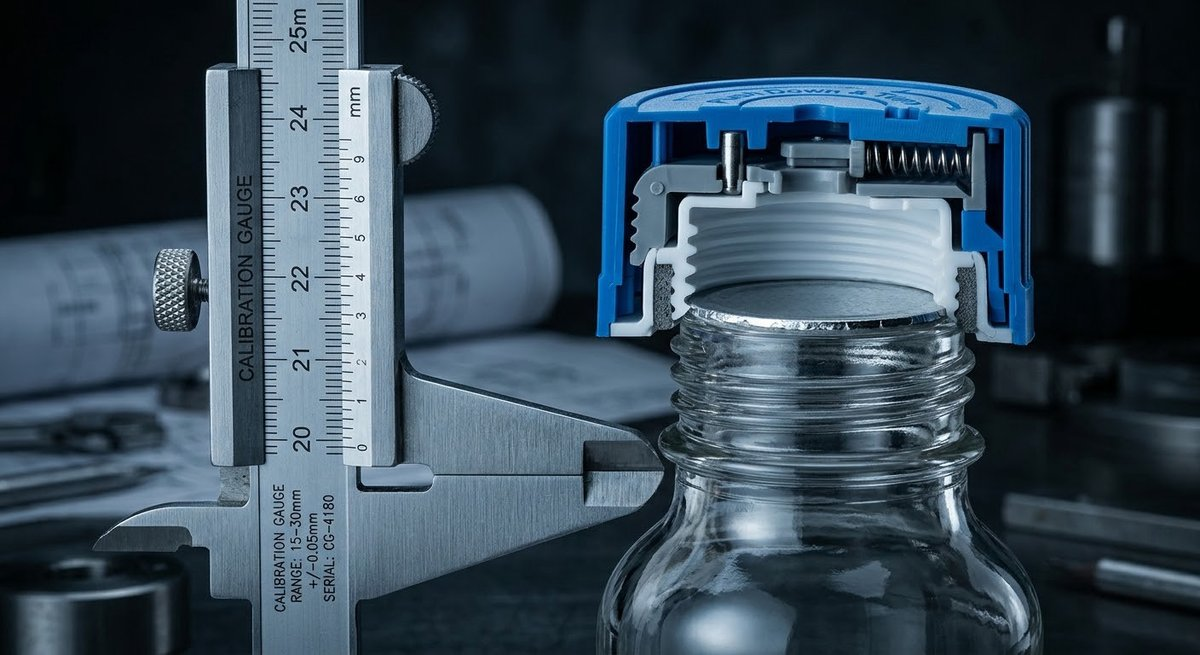
Child-resistant closures live on tight margins. A push-and-turn cap needs enough resistance that small hands cannot defeat it, yet the forces come from a chain of parts — cap skirt, liner, neck finish, thread geometry — each carrying its own tolerance, and tolerances stack. A cap that tests comfortably at nominal dimensions can sit near the pass/fail boundary at the extremes, and production will visit those extremes.
We saw this on a recent pre-test: the cap opened at spec torque on the golden sample, but two of ten units from the pilot run opened noticeably lighter. Mold variation had shifted thread engagement. Ten for ten on one sample is not ten for ten across a production run.
Snap fits and creep
Two-piece CR caps and snap-fit pouch zippers rely on interference fits that creep over repeated openings. A package that passes panel testing fresh can loosen after a shelf-life cycle of temperature swings. Responsible labs test after conditioning — your pre-test should too.
Failure Family 2: Assembly & Manufacturing Drift
Assembly direction and liner seating
CR performance depends on how the package is assembled, not only how it is molded. A liner seated off-center changes the seal. A zipper closed with film caught in the track behaves differently on the tenth cycle than the first. The assembly document the factory follows and the one the lab assumes must be the same document.
Batch drift is the silent killer
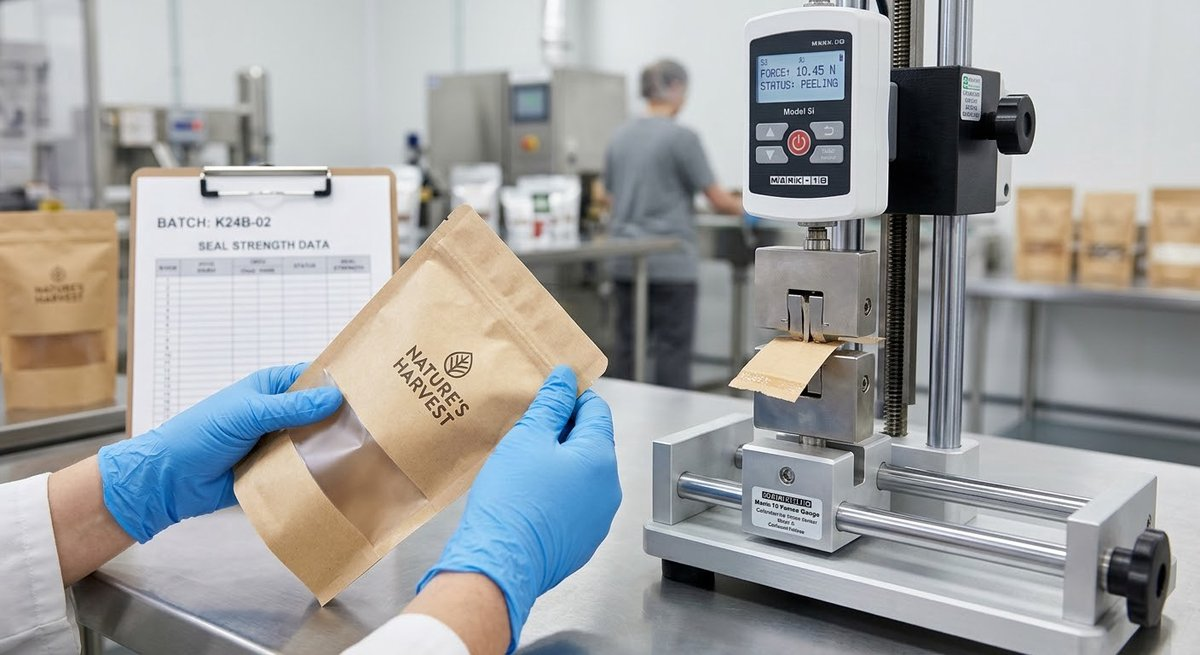
Resin lots shift. Molds wear. Humidity moves heat-seal strength on pouches. A line producing passing units in March can drift by September. Factory seal checks catch gross failures — open seals, leaks — but they do not measure the child-resistance margin, because that requires a panel, not a gauge. The honest bridge: ASTM F88-style seal peel testing in-house, plus periodic lab re-tests of production units.
Failure Family 3: Senior-Use Panel Losses
The accessibility balance
The senior-use panel is where confident designs go to fail. A closure engineered to be genuinely hard for a 4-year-old is frequently hard for a 70-year-old with arthritis. Grip surfaces too small to feel, torque above comfortable wrist strength, push-points needing fingertip precision — each is a legitimate choice until the panel data says otherwise.
Instructions are part of the package
Panel participants open the package with the instructions provided. If the opening sequence lives on the back panel in 6-point type under a bar code, expect senior failures that have nothing to do with the mechanism. Instructions that show, in order, where hands go and which direction to push are cheap insurance — and they belong inside artwork approval, not after it.
Passing the First Time: The Pre-Test Checklist
Test before you tool
The highest-leverage step: run a pre-test on pilot tooling through a protocol lab before mass production. A pre-test costs a fraction of a relaunch cycle and returns margin data — how far from the pass/fail boundary the design sits, not just pass/fail. A design passing with 5% margin is a different risk than one passing with 60%.
Demand configuration-specific evidence
Supplier certificates must name the tested configuration: closure part number, neck finish, film structure. If the report says "similar," treat it as marketing. For pouches, ask for CR-zipper data on the exact film gauge and lamination you are buying.
Lock the golden sample and incoming QC
Freeze a golden sample set at contract signing. Incoming QC then checks the measurable proxies — removal torque ranges, seal strength bands — against that sample, so drift surfaces at goods-in instead of at a lab three months later.
Put instructions where hands look
Approve artwork with the opening sequence on the primary display panel or lid. Cheapest senior-panel insurance there is.

Conclusion
CR certification is a process, not a sticker. Tolerance design, assembly drift and senior accessibility account for nearly every first-time failure we see, and all three are testable in advance. Run the pre-test, demand configuration-specific reports, lock the golden sample — and treat the lab panel as confirmation, not discovery. Want a second pair of eyes on a closure before tooling? Send us the drawing and target market.
References
ASTM D3475 — Standard Classification of Child-Resistant Packages: https://www.astm.org/d3475-20.html
eCFR 16 CFR Part 1700 — Poison Prevention Packaging Act regulations (§1700.20 testing requirements): https://www.ecfr.gov/current/title-16/chapter-II/part-1700
U.S. Consumer Product Safety Commission (CPSC) — Poison Prevention Packaging: https://www.cpsc.gov/Business--Manufacturing/Business-Education/Business-Guide/Poison-Prevention-Packaging
ASTM F88/F88M — Seal Strength of Flexible Barrier Materials: https://www.astm.org/f0888-21.html