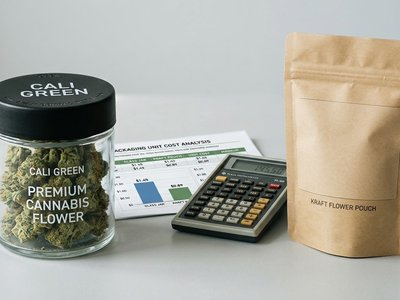
Glass jars vs stand-up pouches for cannabis flower: a 4-bucket TCO model at 10k/50k/100k units covering freight, breakage, shelf life and shelf impact.
The quote sheet says the stand-up pouch costs one-quarter of the glass jar. The quarter-end ledger disagrees. Most packaging comparisons start and stop at unit price. For cannabis flower, that number hides more than it shows. Freight, breakage, shelf-life losses and shelf performance each pull the real gap in a different direction. This article splits packaging cost into four buckets — acquisition, protection, logistics, brand returns — and runs both formats through every one. You end up with a worked model at 10k, 50k and 100k units, plus two decision rules that settle the jar-versus-pouch question per SKU, not per brand.
What "Total Cost of Ownership" Actually Means for Flower Packaging
The four cost buckets
Total cost of ownership (TCO) is a procurement discipline, not a slogan. Applied to flower packaging, it breaks into four buckets:
- Acquisition — unit price, tooling and plate fees, set-up charges, samples, overs.
- Protection — the cost of product that degrades: potency drift, terpene loss, moisture excursions, plus breakage and defect replacement.
- Logistics — inbound freight, dimensional weight on outbound orders, damage claims and the handling time they eat.
- Brand returns — the revenue side of the ledger: shelf conversion, repeat purchase driven by resealability, sustainability optics.
The first three are cost lines. The fourth is a revenue line, but it moves the same ledger, so it stays in the model.
Why unit price alone misleads
Take an RFQ we see weekly on 3.5g and 1oz flower SKUs. Two quotes at 50k units: a digitally printed CR-zipper pouch at roughly $0.18 per unit, a silk-screened glass jar with a CR screw lid at roughly $0.72. The unit-price gap reads as $0.54. It is not.
Add freight-in: 100 empty jars weigh around ten pounds; 100 flat-packed pouches, under two. Add a breakage allowance on the jars, plus the divider trays jar shipping requires. The delivered-cost gap shrinks to roughly half of what the quote sheet implied — before a single jar gets filled. And at premium price tiers the direction can invert, because jar presentation lifts conversion in a way pouches struggle to match. Unit price answers "what does the container cost?" TCO answers "what does the packaging decision cost?" Different questions, different answers.
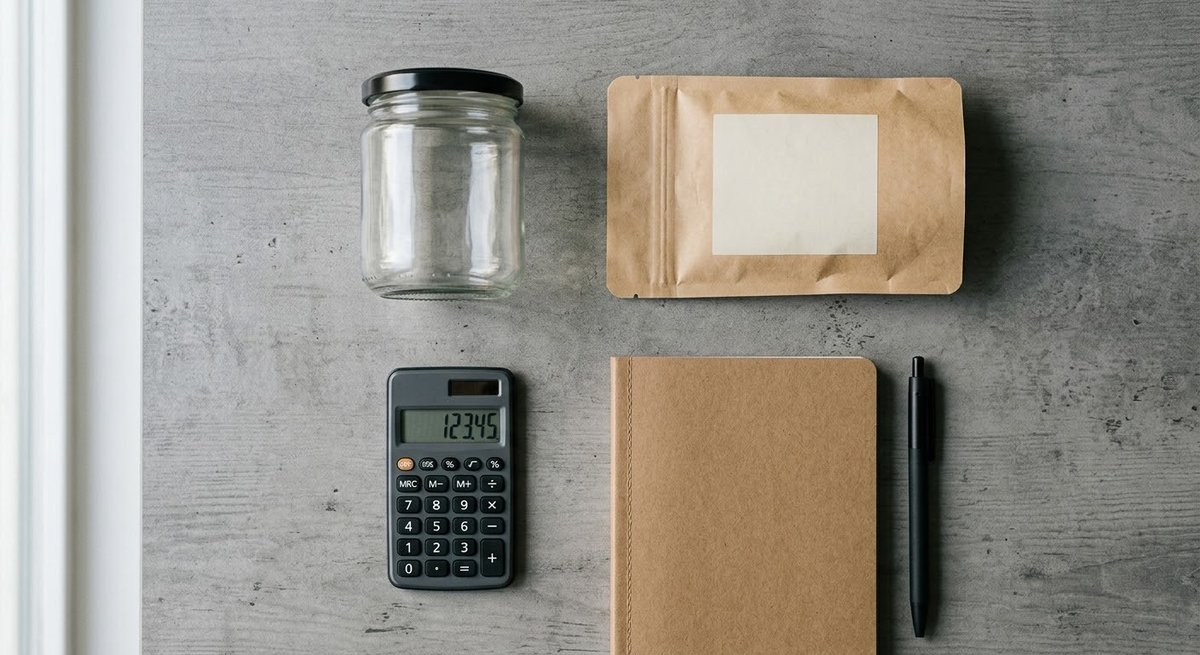
Acquisition Costs: Unit Price, Tooling, and MOQ
Glass jars: higher unit cost, easier entry
Glass jars carry the higher sticker price but the easier entry. Stock jars sit in distributor warehouses at low or no MOQ, which makes them the default for launches and small batches. The cost drivers on top of the base jar:
- Decoration — silk-screen printing is charged per color; pressure-sensitive labels cost less but risk peeling on condensation; shrink sleeves cost more and read premium.
- Closures — child-resistant lids (push-and-turn or CR-lined screw caps) add a real per-unit premium over standard lids.
- Accessories — humidity pack clips, foam inserts, tube-over-jar systems: each one adds a line.
Decorated, CR-lidded 1oz stock jars typically land in the $0.60–0.90 range at moderate volumes, depending on decoration count and lid type.
Stand-up pouches: steep volume curve
Pouch pricing follows volume. The unit-price curve drops sharply as quantity rises, and digital printing removes plate charges on short runs — which is why pouches dominate short-run custom work. The drivers:
- Barrier film grade — the barrier spec moves the price. Film layer stacks were covered in a recent article; this section stays on cost.
- Closure upgrades — a CR zipper carries a real per-unit premium over a standard zipper, and most legal markets make it non-negotiable.
- Structural features — gussets, tear notches, hang holes: pennies each, but they compound.
At 50k units, a printed CR-zipper pouch typically lands in the $0.20–0.35 range, and the curve keeps bending down through 100k.
The hidden line items
Three items routinely break quote comparisons:
- Tooling and plates — one-time charges per design or color. Amortize them across the order before comparing.
- Set-up fees — charged per production run; they punish short runs and frequent redesigns.
- Overs — the industry convention of shipping and billing 3–10% above ordered quantity. Standard practice, not a scam — but it belongs in the model.
Make every supplier itemize quotes the same way: per-unit price, one-time fees, overs policy, Incoterms. Compare at the delivered, per-fillable-unit level. A quote that cannot be itemized is a quote you cannot compare.
Protection Costs: Shelf Life, Terpene Retention, and Breakage
Barrier performance in cost terms
Glass is inert: near-zero oxygen transmission and no flavor scalping. But the jar is only half the system — the closure is the other half. A cheap liner or a worn thread seal surrenders the glass advantage at the exact point where oxygen enters. On recent production runs we have seen CR screw lids fail seal checks on torque variation alone; spec the closure with the same rigor as the vessel.
Pouch protection comes from film quality, and film quality is specified with numbers: oxygen transmission rate (OTR) under ASTM D3985, water vapor transmission rate (WVTR) under ASTM F1249. Ask suppliers for published values, not the adjective "high-barrier." A laminate that misses spec does not fail at the factory. It fails months later as potency drift, and potency drift turns into discounting, returns and lost repeat business.
Humidity management as a cost line
Flower holds best at 58–62% RH. Both formats get there with two-way humidity packs at roughly $0.10–0.20 per unit — write the same line into both columns. The formats differ in context: rigid jar walls protect bud structure and keep the pack seated; pouches need enough structure and headspace that flower is not crushed and the pack can work. For the model, the point is simple: humidity control is a fixed line both formats pay, and it rarely decides the comparison.
Breakage and defect rates
Glass breaks — in filling lines, in transit, on dispensary shelves. A realistic allowance is 1–3% depending on handling, and every broken jar is a sunk container plus a cleanup. Pouches fail differently: pinholes, seal failures, zipper delamination. Defect rates on a competent film line run well under 1%, and failures usually surface at seal-check inspection rather than in a customer's hands. Neither format is loss-free; they lose differently. Jars lose containers. Pouches lose units.
Logistics Costs: Freight Weight, Volume, and Damage
Dimensional weight math
Glass is heavy and rigid; pouches are light and flat. The numbers:
- 100 empty 1oz jars: roughly 10 lb, shipped in protective cartons with dividers.
- 100 flat-packed pouches: under 2 lb, shipped as a thin parcel.
On inbound freight that is a 5x weight gap before you fill either format. Outbound it compounds: e-commerce flower orders in jars pay dimensional weight on the box, padding and dividers, while pouches flatten into small-mailer territory. At scale, freight is where pouches repay their film-grade premium fastest.
Transit damage economics
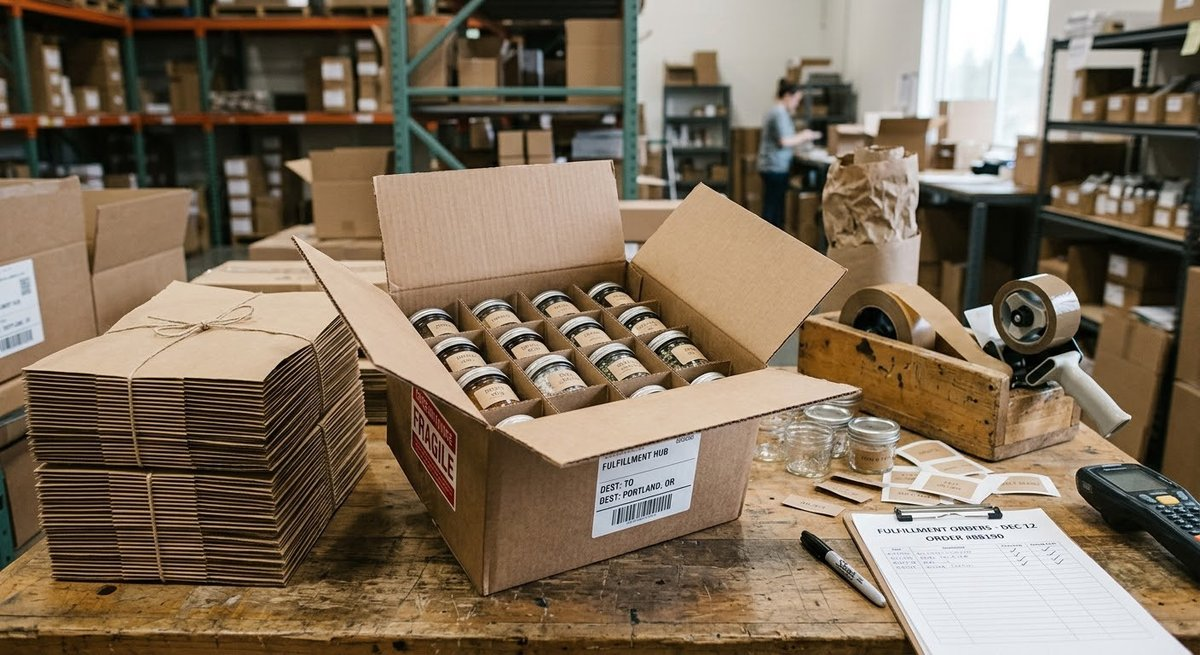
Jars need divider trays, foam and double-wall cartons to survive parcel networks — packaging around the packaging. Every layer adds cost and cube. Pouches tolerate vibration well but need puncture protection against sharp edges in mixed freight. A damaged jar means a claim, a refund and a replacement fill; a damaged pouch usually means crushed flower — worse per incident, far rarer with proper void fill. Design transit packaging to the standard you sell into; distribution performance testing under ASTM D4169 exists for exactly this decision. And price the transit kit into the TCO — it is the line everyone forgets until the first damaged-order email.
Brand & Retail Returns: Shelf Presence, Resealability, Reuse
Shelf impact
Jars sell from the shelf. Weight, glass clarity and the premium-object cue do work graphics alone cannot, which is why top-shelf flower keeps migrating to glass. Pouches counter with face real estate: a full-panel print canvas, matte or soft-touch lamination, and a lower profile that fits more SKUs per linear foot. Neither wins outright — they sell different stories. Jar: craft and potency. Pouch: brand and assortment.
Resealability and consumer behavior
Both formats reseal — screw lid versus zipper — but usage differs. Jars get opened, admired, resealed and displayed at home; the ritual supports the premium price. Zipper pouches win on the seal you can feel: an audible close, a flat profile for the stash drawer, grams-per-dollar value positioning. Post-opening freshness complaints track closure quality more than container type — a well-sealed pouch preserves as effectively as a lidded jar in real use. The model line here is repeat purchase: whichever format your customer trusts to stay fresh is the one they buy again.
Sustainability perception
Lightweighting is the pouch's story: a few grams of film versus a heavy glass vessel, with correspondingly lower transport emissions. Glass counters with recyclability and reuse — consumers keep good jars. Both stories can be told honestly, and both can be greenwashed into trouble. Keep the claim specific and verifiable: the recyclability of the actual film structure, the actual glass recycling streams in your market. PCR-content compliance rules were covered in a recent article; this section stays on perception and weight.
Building Your TCO Model: A Worked Example and Decision Rules
A worked example
Assumptions: 3.5g or 1oz flower SKU, US domestic fill, parcel-plus-freight mix, decoration included, CR closure mandatory. Figures are illustrative market ranges — replace with your own quotes before deciding:
| Cost line (per fillable unit) | Glass jar (50k) | CR-zipper pouch (50k) |
|---|---|---|
| Decorated container, delivered | $0.78 | $0.26 |
| Humidity pack | $0.14 | $0.14 |
| Transit packaging kit | $0.09 | $0.03 |
| Inbound freight share | $0.07 | $0.01 |
| Breakage/defect allowance | $0.03 | $0.01 |
| Acquisition + logistics subtotal | $1.11 | $0.45 |
At 50k units the jar still costs about 2.5x the pouch on hard costs. What remains is the brand line: if jar presentation lifts conversion or supports a $10 higher shelf price, the ledger flips. At 10k units, pouches with digital printing avoid plate amortization and stretch their lead. At 100k, pouch unit pricing keeps falling while jar pricing mostly plateaus — volume widens the pouch advantage on hard costs, not the reverse.
Two decision rules
- Premium flower, boutique volumes, in-store-heavy channel → jar. Presentation premium and the reuse cycle outweigh hard costs at low volume.
- Volume SKUs, e-commerce-heavy channel, price-tiered lines → pouch. Freight, flat-pack density and the volume curve win, and a modern CR zipper closes most of the freshness gap.
Most brands run both, by tier: glass for head flower, pouches for the volume line. That is not indecision — it is the TCO model talking.
Conclusion
Unit price is one of six inputs. Jars cost more to buy, more to ship, and they break; pouches cost less at volume and travel flat, but their protection is only as good as the film spec you enforce. Run the four buckets — acquisition, protection, logistics, brand returns — before your next RFQ, and let crossover volumes pick the format per SKU. Want a head start? Request our quote-comparison template and drop in your own numbers.
References
- ASTM D3985 — Standard Test Method for Oxygen Gas Transmission Rate Through Plastic Film and Sheeting Using a Coulometric Sensor: https://www.astm.org/d3985-20.html
- ASTM F1249 — Standard Test Method for Water Vapor Transmission Rate Through Plastic Film and Sheeting Using a Modulated Infrared Sensor: https://www.astm.org/f1249-20.html
- ASTM D4169 — Standard Practice for Performance Testing of Shipping Containers and Systems: https://www.astm.org/d4169-23.html
- Institute for Supply Management (ISM) — total cost of ownership in procurement: https://www.ismworld.org/